Enterprise AI adoption is at its tipping point. We here at Opine see companies using horizontal AI platforms to build agents but is it really working? A Mckinsey study mentioned that 78% of organizations use AI in at least one business function, yet 80%+ report no measurable impact on EBIT. The gap is between those scaling production deployments vs. staying stuck in pilots.
For revenue teams specifically, this decision carries unique stakes. You're not just adopting AI for internal productivity. You're deploying AI in front of customers, and the quality of your agent directly impacts your win rate.
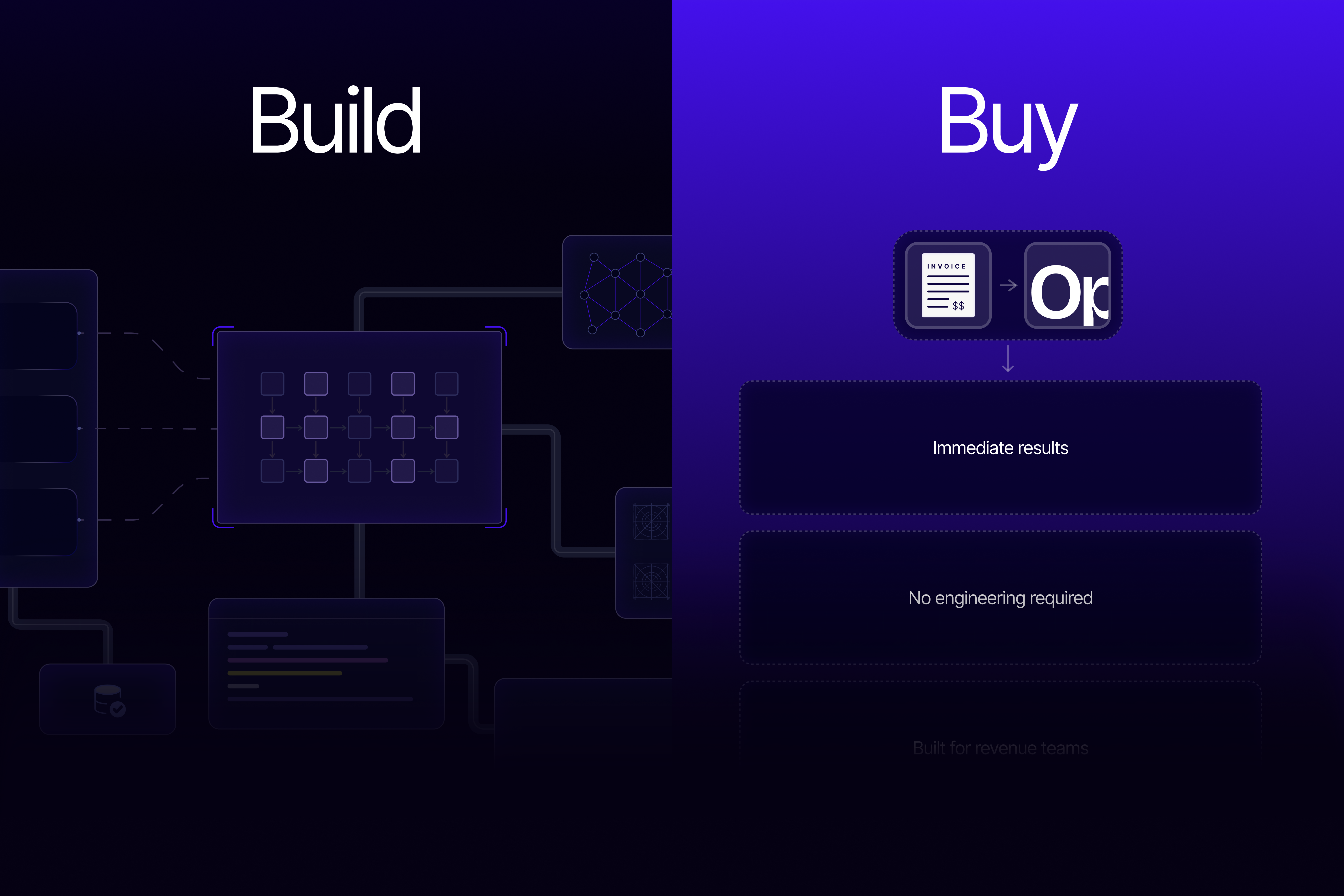
Let's walk through what the build vs. buy decision actually looks like for AI agents across the sales funnel from discovery and qualification to proof-of-concepts and post-sales handoff.
The Three Costs of Building
When you're thinking about building versus buying any technology, you need to consider three costs: upfront build cost, ongoing maintenance cost, and opportunity cost. For AI agents in sales, all three are deceptively high.
1. The Build Cost
Building something that feels like an enterprise-grade AI agent on top of Claude, Glean, or n8n starts with a false economy. The pitch is simple: hook up an LLM API, write some prompts, maybe build a workflow in n8n, and you've got an agent.
But here's what that reality actually looks like. You're not just paying for API credits. You're paying for the person who writes those prompts, tests them, debugs them, iterates on them, and ultimately makes sure the agent doesn't hallucinate a technical requirement during a discovery call. That person needs to understand sales methodology, technical sales cycles, proof-of-concept structures, and the specific language your product uses.
Multiple enterprise SaaS companies we've worked with have committed 7 figures (sometimes 8) to AI transformation across their revenue org. None of them have a fully operationalized use case to show for it. That's not because they hired the wrong engineers or picked the wrong model. It's because building production-grade AI for sales that includes consistent AI execution in 90%+ of applicable situations. This is a different shape of problem than the build estimate accounts for going in.
2. The Maintenance Cost
This is the cost that almost always gets missed in the original conversation. LLMs evolve. APIs change. Sales processes change. New reps come onboard. New products get launched. Every one of those changes breaks something in your build.
The pattern is the same in sales: the maintenance burden accumulates quietly, and by the time you feel it, you're already behind.
3. The Opportunity Cost
What could your best sales engineer be doing if they weren't building and debugging AI agents? What could your head of presales be focusing on if they weren't prompt-engineering qualification criteria?
At Opine, we see customers allocate zero engineering time to building agents and still get full funnel coverage. Those engineering hours go back into product innovation. Those presales hours go back into running proof-of-concepts that close deals.
Context is what separates personal projects from a tool
This is the part of the build conversation that rarely gets addressed honestly. An AI agent is only as good as the context it's operating in.
When you build a one-off agent on Claude or Glean for a single sales workflow, you're building in a context vacuum. Your discovery agent has no knowledge of the qualification criteria it collected. Your POC agent has no context on the objections surfaced during technical validation. The agents don't talk to each other. The data fragments. Every interaction resets.
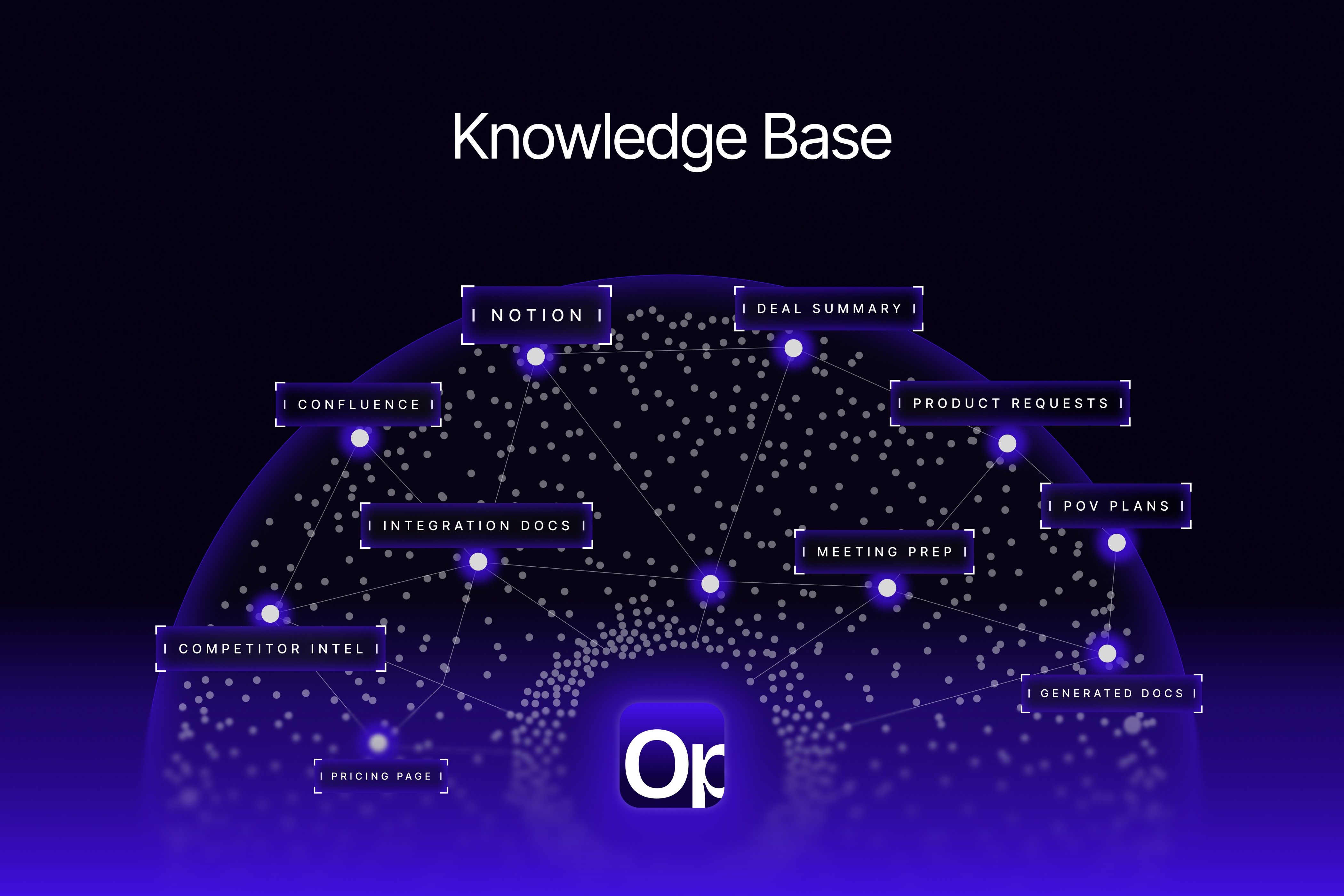
Opine is built on a fundamentally different premise: every agent operates on a shared, high-signal sales context layer. Every call, every Slack message, every email, every demo recording feeds into a unified deal intelligence model. The discovery agent's output becomes the qualification agent's input. The proof-of-concept outcomes become the post-sales handoff brief. The agents are connected, aware, and contextually grounded.
That's the difference between building one generic agent that tries to do everything and buying a platform where every agent is trained on your specific sales context and gets smarter every time it runs.
Evaluation and Correctness in build vs buy
If you're building agents that operate on live customer interactions, you need a way to evaluate whether they're correct. AI models are non-deterministic. Prompt drift is real. And when your agent is the one classifying deal risks or surfacing technical objections, a wrong answer isn't just an error it's a lost deal.
Opine has built evaluation frameworks that continuously assess agent accuracy across every stage of the funnel. We measure precision, recall, and consistency against human-labeled ground truth. We track performance degradation over time. We surface edge cases and feed them back into model improvement. Doing this from scratch is not a weekend project, it's a dedicated ML engineering effort.
For teams evaluating whether to build or buy, this is the question that should carry the most weight: if you build it, who owns correctness? If you buy it, the vendor does.
What makes sense with respect to ROI
When Building Makes Sense
We're not going to pretend that building never makes sense. It absolutely does in specific scenarios.
If you're a leader building a personal productivity workflow, building on Claude Code or Codex makes total sense. A sales leader plugging into tools to create a personal dashboard they use every day? That's basic individual AI productivity. Small teams that can just share Claude Projects and talk about how to use them are fine to build. If your opportunities or customer context all fit in a context window easily, building is totally reasonable.
The distinction is scope. Individual AI productivity is not the same as organizational AI infrastructure.
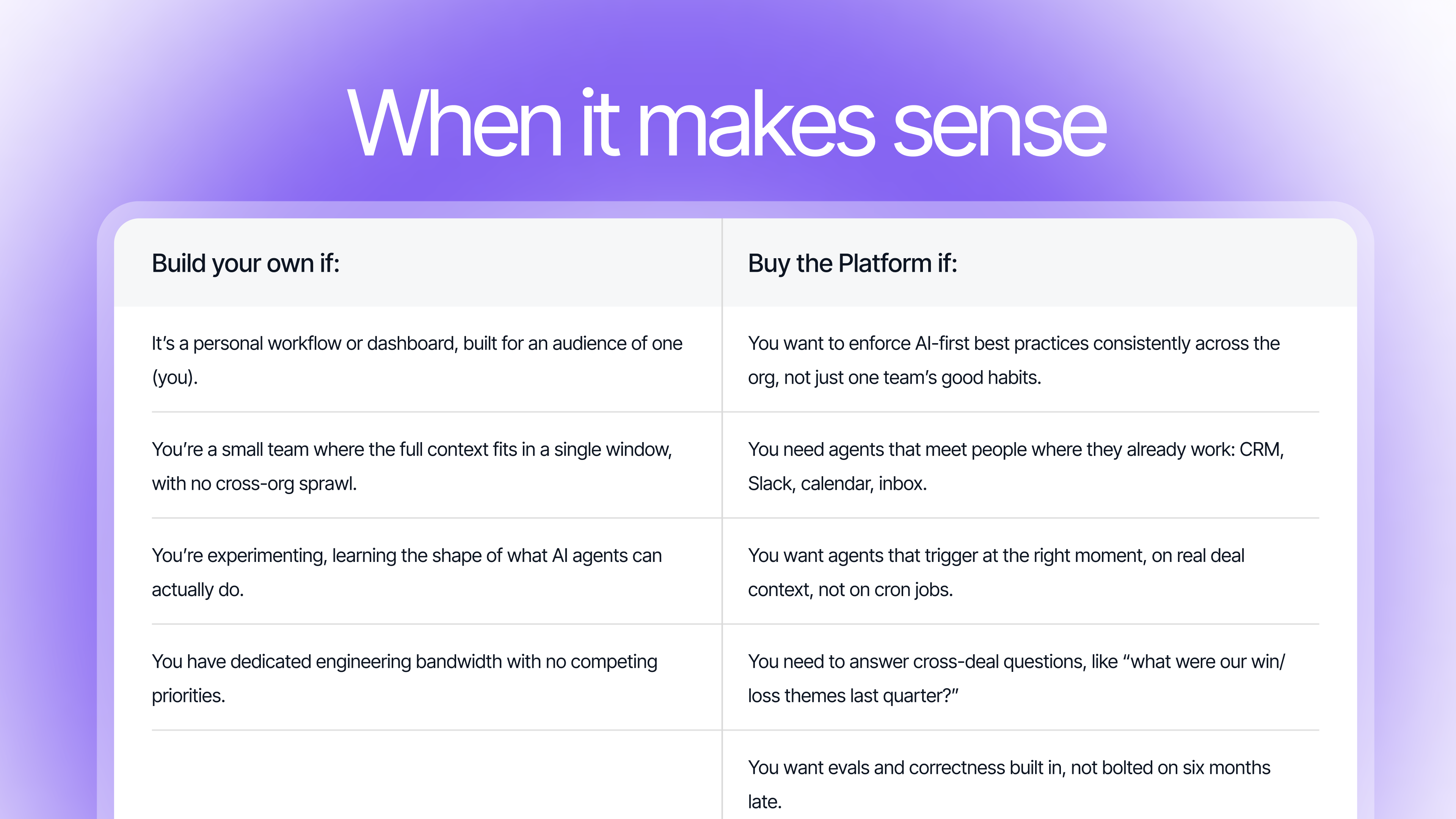
Once you move beyond individual productivity into organizational AI infrastructure for revenue teams’, the build conversation changes completely. And that's where Opine comes in.
At Opine, we see similar patterns. Our customers report an average 26% increase in win rates from the evaluation and proof stages. They save 50+ hours per rep per week on manual deal documentation. They onboard new presales team members 60% faster because every deal's context is already centralized and AI-accessible.
The build cost, the maintenance burden, the context problem, the evaluation challenge they all converge on one question. Will building this in-house drive revenue faster than a platform that was purpose-built for your sales process?
What Sets Opine Apart
We're not a horizontal AI platform. We're not an agent framework. We're a GTM orchestration platform purpose built specifically for the stages that matter: discovery, qualification, technical validation, proof-of-concept, and post-sales handoff.
Here's what that means in practice:
1. Pre-built agents that work out of the box, no prompt engineering, no model fine-tuning, no context setup. You plug in your CRM, your call recordings, and your Slack, and the agents start working within days.
2. A shared context layer across every stage qualification criteria from discovery flow into POC planning. Competitive objections from a demo automatically inform the technical validation agent. Every conversation is connected and context is shared across the sales cycle - which makes data and information more accurate and rich.
3. Built-in evaluation and correctness every agent output is scored, tracked, and continuously improved. You get visibility into agent performance, not just agent outputs.
4. Zero engineering time required your presales team gets the tool. Your engineering team stays focused on your product, not your sales automation.
Which side should you lean into?
The build decision feels empowering at first. You have control. You have flexibility. You can customize everything. But that's the trap. The complexity, the maintenance burden, the context gaps, and the evaluation overhead compound quickly and what started as a lightweight automation project becomes a full-time engineering commitment.
The buy decision feels like you're giving up control. But you're not. You're choosing a partner that owns the infrastructure, stays on top of model changes, and gives you production-grade agents trained on the exact sales workflows you already run.
The teams who are winning this year aren't the ones who built the most sophisticated AI. They're the ones who bought the right tool early and went back to doing what they do best, closing deals.
Want to see what Opine looks like in your environment?
Book a demo and test agents on your real deals.
Get the latest in your inbox
Get weekly tips & strategies from your friends at Opine to close faster, reduce risk, and grow revenue.
Recent articles
Explore the Opine archive of blog articles on presales, sales, and customer success automation. From strategies, best practices, to angentic AI-driven revenue growth, you'll find it here.